Theological covenants
Out of all these texts theologians draw the conclusion that there is something special about the substance of God. God longed in some way to know somebody, that would have character like him. Having the choice to do evil, though choosing to do good. This is truly ruling. This is what God commended Adam to do (Genesis 1:28). So He did give Adam the ability to sin (Genesis 2:16-17). This has been named the "covenant of works," or the "Edenic covenant"1 (Named after the garden of Eden).
In this "covenant of works" the ability was given to set the devil in his rightful place, by means of a weaker being. So that the weak things of God, would still be wiser than the most wise plan the devil could think of. satan the god of this WORLD, watch carefully, NOT god of this earth, would be taught a painful lesson! The word for "world," is "κοσμος" (=kosmos), where our word "cosmetics" comes from. This is an arranged structure, an arranged set of order. In English, when we use the "world," we think about the "globe," or the "earth." In the bible though there is a big difference between "κοσμος" (=kosmos) and "γη" (=gē). "γη" (=gē) is the earth, globe, land. But "κοσμος" (=kosmos) is the arranged system of order, think about the world of economics, politics, education, culture, religion, sports, use of leisures, media, etc. Everything that has breath shall praise the Lord. Every knee must bow to God. This whole system, will be taken over by the Kingdom of God, that is what Jesus preached. The earth, "γη" (=gē), is the Lords, it belongs to Him. (Matthew 5:5 and Matthew 11:25, Psalm 2:8; 24:1; 97:5, 7; 98:3-4) The earth stayed the Lord's, even after the fall of man. Although there was a place given to the devil, still the earth was the Lord's, and a complete chaos where nothing functioned no more stayed out. Although this is what dispensationalists seem to preach.
God in eternity past, foresaw that mankind could go wrong. Because of this He decided, God the Father, God the Son, and God the Holy Spirit, the Trinity, that Jesus would be sent to deliver mankind. The Holy Spirit would be sent to, after Jesus His coming, bring Gods people to the glory which dwelled and manifested in Jesus, until the full earth would be restored under the rule and dominion of Christ. Jesus was slain for the foundation of the earth. (Revelation 13:8, (KJV), (NKJV); 1 Peter 1:20; Hebrews 9:24-28; Revelation 17:8 also see Matthew 13:35). Just once He came to the earth to die, and the Son entered in the fullness of times into our chronological time. But to God time is not what it is to us, as revealed by the scriptures I already quoted. Covenantal Theologians speak about the "Covenant of Salvation" or "Redemption."
The last made theological implication is the "Covenant of Grace." This Covenant is all the described Covenants of the bible from Genesis 3:15 up to, and including, the New Covenant. The glory of the New Covenant will be seen completely by the physical Return of Christ. When He will be seen face to face (1 Corinthians 13:12).
Either a form of Covenantal Theology or Dispensationalism
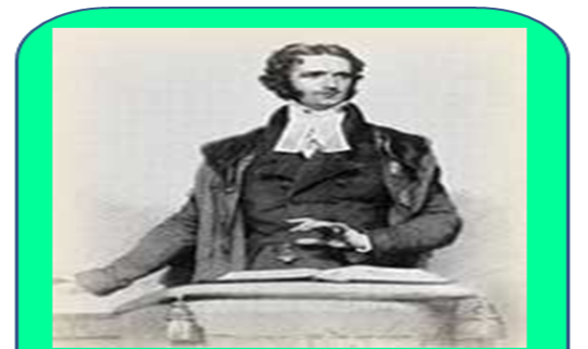
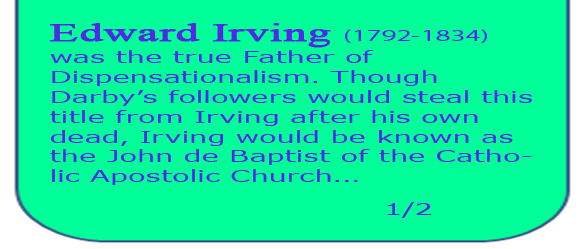
Around 1830 there has arisen a teaching out of the ministry and person of Edward Irving in London (then the Capital City of the world). This teaching would soon be picked up by Darby, Scofield and Larkin. This teaching resists itself against Covenantal theology, because it claims that the New Covenant is just like all other Covenants meant just for the Jews. God has according to these dispensationalist two covenantal people, namely the Jews and the Christians.
The Christians according to them have no part in the covenant to Abraham, Moses and the promised land, the Davidic and New Covenant (Lately some dispensationalists doubt that, and believe the New Covenant to be just as well for Christians. See for instance, p. 109-113 of W.J. Ouweneel and his Dutch book: "Sta op en laat u dopen" (English translation of the title would be: "Stand up and let yourselves be baptized," published only in Dutch by Telos, Uitgeverij Medema, ©2005). This book directly reveals on page 109 that Ouweneel has totally moved away from the opinion of Darby and contemporary writers like Ryrie. These last two hold that the New Covenant is not valid for Christians. But they all, including Ouweneel continue to believe that Christians would be a new people, in time between the fulfillment of Israel's ultimate promises, so that God could still have mercy on the rest of the world.
People should consider that the names do not carry the key to the difference between dispensationalists and believers in covenantal theology. The dispensationalists believe in covenants, although they see these different than believers in covenantal theology, and believers in covenantal theology believe in dispensations, although they view them in a different way that dispensationalists.
The difference between Dispensationalism and Covenantal theology is been clearly described by a well known American writer, Charles C. Ryrie. He gives 3 points of differences:
Dispensationalists should be:
1. "The only one" that see that the "primary purpose of God is to glorify Himself."2 Unfortunately for Ryrie, this is NOT SO.
In one of the Calvinistic creeds, "The Westminister Confession of Faith" exactly these same words are said in Chapter 3.
So now we see that both believers in Calvinistic Covenantal theology 3 believe exactly the same thing concerning this as Ryrie stated
that only dispensationalists believe.
His statement is not only not true for this group, but also other Covenantal Theologians believe that everything is about the glory of God.
But some would state to leave the subject there would be "too vague" for the Christian faith.
They would argue that it is important to clarify this even as the bible itself does.
The GLORY OF GOD WAS WALKING AND REVEALED ON EARTH IN CHRIST (John
1:14; Colossians
2:9).
By believing in Him, and to be focussed on Him, living for the glory of God becomes easy and practical!
Because the Glory of the Father is revealed in the Son.